Taj Mahal: Everything You Need to Know Before Visiting
- Tanya Prasad
- Feb 20
- 7 min read

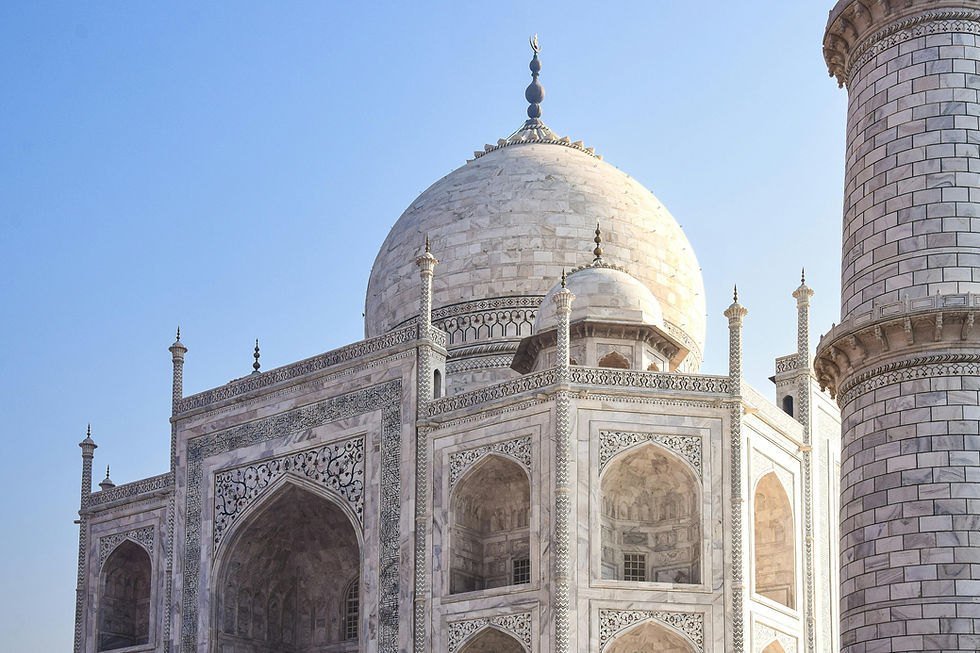
There are places you see in photos your whole life, and then there are places that actually stop you in your tracks when you show up in person. The Taj Mahal is one of those places. No matter how many pictures you've scrolled through or documentaries you've half-watched, nothing quite prepares you for standing in front of it for the first time. If you're planning a trip to India and knowing where is the Taj Mahal is on your list, this guide will make sure you're ready to experience it the right way.
What Makes the Taj Mahal One of the World's Greatest Wonders
It's not just the size, though the scale is genuinely impressive. It's not just the white marble, though that alone would be worth the trip. What makes the Taj Mahal extraordinary is the combination of everything at once. The symmetry is almost unsettling in how perfect it is. The way the building reflects in the long pool that runs through the central garden feels intentional in a way that modern architecture rarely achieves. And the emotion behind it, the fact that the whole thing was built as an act of grief and love, gives it a weight that most monuments simply don't have.
It was designated a UNESCO World Heritage Site in 1983 and is widely considered one of the finest examples of Mughal architecture anywhere in the world. Millions of visitors come every year, and the vast majority say it exceeded their expectations. That's a hard thing to pull off for a place with that much hype.
The History Behind the Taj Mahal and Its Construction
The story of the Taj Mahal begins in the seventeenth century, during the height of the Mughal Empire in India. The Mughals were known for grand architecture, but this project was on a different level entirely. Construction began around 1632 and took approximately 22 years to complete, finishing around 1653. That timeline alone tells you something about the ambition involved.
The main mausoleum was completed first, followed by the surrounding structures including the mosque, the guest house, and the outer gateway. The entire complex sits on a raised platform and is oriented toward the Yamuna River, which runs along the northern edge of the grounds. The project reportedly involved over 20,000 workers, artisans, and craftsmen from across the Mughal Empire and beyond, including specialists from Persia, the Ottoman Empire, and Europe.
The cost at the time is estimated to have been around 32 million rupees, which in today's terms would translate to an almost incomprehensible figure. Materials were sourced from across Asia, including white marble from Rajasthan, jasper from Punjab, jade and crystal from China, turquoise from Tibet, and lapis lazuli from Afghanistan.
Who Built the Taj Mahal and Why It Was Created
The Taj Mahal was commissioned by Mughal Emperor Shah Jahan in memory of his third wife, Mumtaz Mahal. She died in 1631 while giving birth to their fourteenth child. By all historical accounts, their relationship was genuinely close, and her death devastated him deeply. He reportedly went into mourning for two years and emerged with the intention of building something the world had never seen before.
Mumtaz Mahal's tomb sits at the very center of the main mausoleum. Shah Jahan's own tomb was added later, placed beside hers after he died in 1666. He spent the last years of his life under house arrest, imprisoned by his own son Aurangzeb, and it's said he spent those years looking at the icon of love from a window in Agra Fort nearby.
The chief architect is widely credited as Ustad Ahmad Lahori, a Persian architect who served in the Mughal court. The design drew heavily from earlier Mughal tombs but pushed every element further in terms of scale, material quality, and precision.
The Architectural Details That Make the Taj Mahal Unique
The main dome is probably what most people picture first. It rises about 115 feet above the base and is surrounded by four smaller domed structures called chattris. The central dome is often described as an onion dome, and it's flanked by four minarets, one at each corner of the raised platform. These minarets are very slightly tilted outward, which was a deliberate design choice so that if they ever fell, they would collapse away from the main structure.
The white Makrana marble that covers the building is not just decorative. It changes appearance depending on the light. At sunrise, it can look pinkish and soft. In full daylight, it appears bright and almost blinding white. At dusk, it turns golden. Under moonlight, it looks silver. This quality was intentional and adds to why so many visitors try to see it at multiple times of day.
The surface of the marble is covered in intricate inlay work called pietra dura, where semiprecious stones are set into the marble to create floral patterns and calligraphy. The calligraphy panels on the main entrance are designed so that the lettering appears uniform in size even though the top letters are actually larger than the bottom ones, a visual trick that accounts for the angle at which you view them from the ground.
The garden layout follows a formal Persian garden design called a charbagh, which divides the space into four equal quadrants using pathways and water channels. The long reflecting pool runs from the main gateway straight toward the mausoleum and is one of the most photographed features of the entire complex.
What to Expect When You Visit the Taj Mahal Today
The complex is located in Agra, in the northern Indian state of Uttar Pradesh, about 130 miles south of Delhi. Most visitors reach it by a fast train from Delhi, which takes around two hours, or by car, which can take three to four hours depending on traffic. Agra has its own airport, though most travelers fly into Delhi and make a day trip or overnight stay out of it.
Entry tickets are priced separately for Indian citizens and foreign nationals. As an American traveler, expect to pay a higher entry fee, which is standard across most major monuments in India. The ticket includes shoe covers and a bottle of water, and it gives you access to the main mausoleum as well as the surrounding complex.
The site is open every day except Friday, when it closes for afternoon prayers. Security is taken seriously, and there is a list of items you cannot bring in, including food, tobacco, and tripods. Phone cameras are fine. There are lockers available near the entrance where you can store bags that don't pass security checks.
Inside the mausoleum, you'll see the ornamental tombs of Mumtaz Mahal and Shah Jahan at the center, though their actual graves are in a lower level beneath and are not open to the public.
Best Time of Day to See the Taj Mahal in Person
Sunrise is genuinely worth the early alarm. The crowds are smaller, the light is soft and flattering, and the experience feels more personal. The gates open about 30 minutes before sunrise, and serious visitors and photographers tend to show up right at opening. If you can manage it, start here.
The middle of the day from around 10 a.m. to 3 p.m. brings the largest crowds and the harshest light. The marble is still beautiful, but the atmosphere is more chaotic and the heat can be brutal, especially between March and June when temperatures in Agra regularly hit above 100 degrees Fahrenheit.
Sunset is another strong option. The golden light hits the marble in a way that makes the whole structure look warm and almost glowing. Crowds pick back up in the late afternoon, but it's generally more manageable than midday.
Full moon nights are something else entirely. The Archaeological Survey of India offers special ticketed viewings on the night of the full moon and the two nights on either side of it. Seeing the Taj Mahal under a full moon is considered one of the most memorable experiences India has to offer, and spots are limited, so book ahead if you're planning your trip around this.
Tips for Getting the Most Out of Your Taj Mahal Visit
Plan to spend at least two to three hours inside the complex. Many visitors try to rush through it, and they consistently say they wish they'd stayed longer. There's a lot to take in, from the inlay details up close to the view from different angles in the garden.
Wear comfortable shoes that are easy to slip on and off. You'll need to remove them or wear the provided covers before entering the mausoleum. Light, breathable clothing is strongly recommended regardless of the season, and if you're visiting between October and March, bring a layer for the early morning chill.
Hire a licensed guide. The Archaeological Survey of India keeps a list of certified guides at the entrance. A good guide will point out details you would never notice on your own and can make the history feel genuinely alive. Expect to pay a reasonable fee and agree on it before you start.
If you have an extra day, consider visiting Agra Fort as well. Shah Jahan was imprisoned there, and from one of its towers you can see the Taj Mahal in the distance. That context adds something real to the story.
Frequently Asked Questions
How far is the Taj Mahal from Delhi?
It's approximately 130 miles from Delhi. The fastest way to get there is the Gatimaan Express train, which takes about 100 minutes. By car, expect three to four hours depending on traffic.
Is the Taj Mahal worth a full day trip?
Absolutely. Most visitors recommend spending at least half a day at the complex itself and pairing it with a visit to Agra Fort to make a full day of it.
What should I wear when visiting?
Light, comfortable clothing works best. There's no strict dress code for tourists, though modest clothing is respectful. Bring easy slip-on shoes and, if you're visiting in winter, a light jacket for the early morning.
Can I take photos inside the mausoleum?
You can take photos with a phone camera inside the main complex, but photography inside the inner chamber of the mausoleum is restricted. Follow the posted guidelines and staff instructions.
What is the best month to visit the Taj Mahal?

Comments